Vacuum Truck Bonding Reel: What to Look for in a Field-Ready Spool
What Is a Vacuum Truck Bonding Reel? A vacuum truck...


A motor repair can look complete and still fail again within months. Bearings get replaced, windings pass their tests, the motor runs, and it goes back into service.
Then it comes back with the same failure, and the shop has to explain why a repair that seemed thorough didn’t hold up. This isn’t usually caused by poor workmanship.
Electric motor repair failure happens when a repair addresses the symptoms without identifying what actually caused it. When the root cause isn’t fixed, it damages the new parts the same way it damaged the old ones.
This blog covers where repairs typically fall short and what an electric motor repair shop needs to do differently to reduce comebacks and deliver work that actually lasts.
A repair that fails within months of leaving the shop usually isn’t a one-off. It typically points to a specific gap in the process, and these are the ones that show up most often.
Bearings rarely fail on their own; the real cause is often shaft voltage, misalignment, or contamination.
If that root cause isn’t identified and fixed, the new bearing wears out the same way, usually within a similar timeframe.
On motors running with VFDs, electrical voltage can build up on the shaft.
Without proper grounding, that voltage discharges through the bearings instead. This can wear small wave-like grooves into the bearing race — known as fluting — or create a dull, pitted finish across the bearing balls, known as frosting.
If a repair replaces the bearing but doesn’t add grounding to stop the voltage, the new bearing fails the same way.
A part can fit and still be wrong. If a bearing or seal isn’t built to the exact size the manufacturer specified, it won’t perform the same, even if it looks and fits fine on install.
It can wear faster or run hotter, which cuts the motor’s life short even if everything else about the repair was done right.
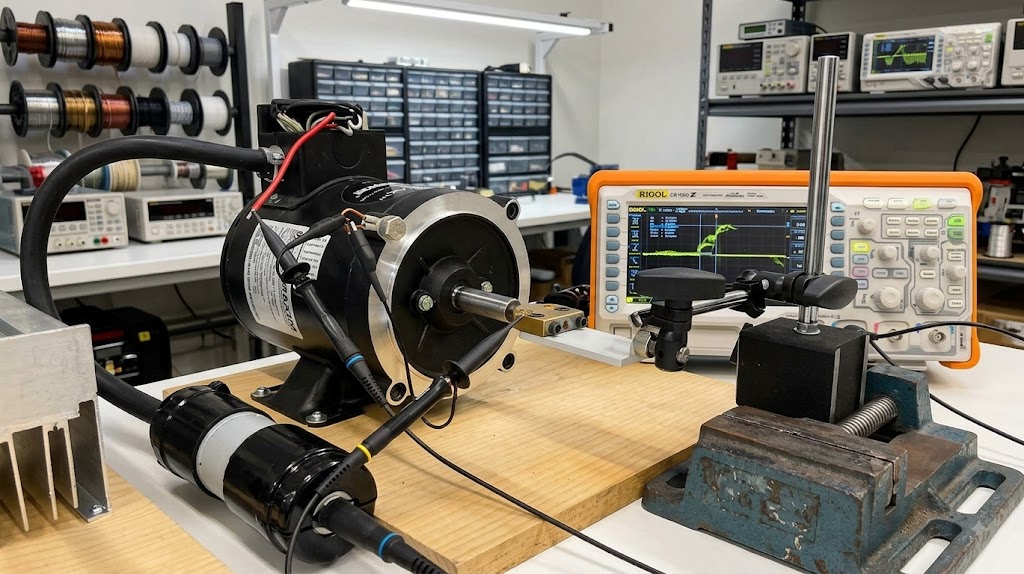
A motor running on the shop floor has only passed the easiest test it will face. Vibration analysis, insulation testing, and shaft voltage checks are what actually confirm the repair holds up.
Without them, problems that should have been caught in the shop show up later, in the field, under real load.
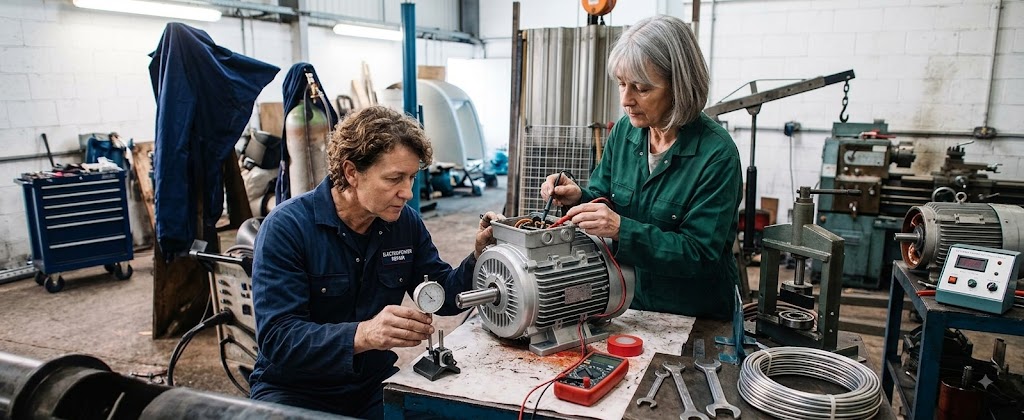
Diagnosis happens before any part is replaced. It determines whether the repair addresses the actual cause of failure or just the symptom.
A proper diagnosis includes:
Two motors can arrive with the same symptom, a seized bearing or a burnt winding, and have entirely different causes. One may be simple wear. The other may involve shaft voltage that will keep damaging every replacement part until it’s addressed. Without diagnosis, both get repaired the same way. Only one of those repairs will last.
Diagnosis adds time to the front of a repair. It costs less than reopening the same motor a few months later.
A quality electric motor repair goes beyond replacing damaged components and restoring operation.
The most reliable repair shops focus on understanding why a motor failed, applying the right repair methods, and taking steps to prevent future problems.
This approach helps businesses improve equipment reliability, reduce downtime, and avoid repeated repair expenses.
If shaft voltage caused a bearing to fail, installing a new bearing without proper shaft grounding leaves the replacement exposed to the same discharge.
If misalignment caused the wear, the alignment needs correcting too.
Replacing a damaged part without fixing what damaged it isn’t a repair; it’s a delay before the same failure happens again.
Bearings, seals, and grounding components need to match the original manufacturer’s tolerances – not just fit closely enough to work.
Installation matters just as much as the part itself: correct press fits, proper alignment, and clean, contamination-free assembly all affect how long the repair holds up under load.
A baseline test before repair work begins helps confirm what’s actually failing.
Once the repair is done, vibration analysis, insulation resistance testing, and shaft voltage checks confirm it holds before the motor leaves the shop – not after it’s back in the field.
Shops that recommend ongoing monitoring, lubrication schedules, or periodic shaft voltage checks help customers catch small issues before they become repeat failures.
It also keeps the relationship going past the repair itself, instead of ending until the next breakdown.
A repair that fails early doesn’t just cost the price of doing it twice. It sets off a chain of costs that go well beyond the repair itself.
Cost to the Customer
Cost to the Repair Shop
For a repair shop, word of mouth still carries more weight than any advertisement. A customer who never has to think about a motor again is the one who calls back for the next job, and mentions the shop’s name when a colleague asks who they trust with their equipment.
Shaft voltage is one of the most preventable causes of repeat bearing failure, and one of the easiest to miss during a standard repair.
Aaki Corp manufactures Motor Shaft Grounding Modules that give shaft voltage a safe path to discharge, protecting the new bearing from the same damage that took out the original.
Installation uses Aaki’s FleXmount™ mounting system, which typically completes in under 20 minutes even on motors with tight endbell geometry.
Modules are shaped with FleXform™ and drilled with DrillBuddy™ to fit a wide range of horsepower ratings and motor configurations.
Aaki also produces static bonding and grounding spools for environments where static discharge is a safety concern, and runs a learning centre covering shaft voltage, eddy currents, and bearing failure in more detail.
As a long-standing EASA member, Aaki works with repair shops that want proper grounding built into their standard repair process – not added only after a motor comes back a second time.
Accurate diagnosis, correcting the actual cause of failure, parts that meet spec, and testing before and after the work is done — each step closes a gap that would otherwise turn into a comeback.
Shops that build these steps into every repair see fewer comebacks, stronger customer trust, and a reputation that brings in repeat business without having to chase it.
Skip any one of them, and the cost just shifts to the customer’s downtime or the shop’s own margin later.
If shaft voltage, fluting, or frosting are showing up as repeat problems in your shop, Aaki Corp’s grounding solutions are a straightforward way to close that gap. Get in touch with Aaki to talk through your repair process and find the right grounding solution for the motors you work on.
1. How do I know if a motor failure was caused by shaft voltage?
Look for bearing fluting (wave-like grooves) or frosting (dull, pitted finish) on the bearing race or balls. Shaft voltage testing before and after repair can confirm whether it’s an active issue.
2. Does every VFD-driven motor need shaft grounding?
Not every motor will show visible damage. But any motor running on a VFD carries the risk. Grounding is generally recommended as a preventive step – not something added only after a failure.
3. How much does adding shaft grounding to a repair typically cost?
Grounding modules are relatively low-cost. Compared to the cost of a repeat bearing failure, the investment is small. Installation also adds minimal time to the overall repair.
4. Can shaft voltage damage happen even with a properly aligned motor?
Yes. Alignment addresses mechanical wear – not electrical issues. Shaft voltage needs its own solution, like proper grounding, regardless of how well the motor is aligned.
5. How often should a repaired motor be retested after it’s back in service?
This depends on the application. Periodic vibration and insulation checks are a good baseline. For VFD-driven motors, shaft voltage monitoring should be part of that routine too.